
There are no second takes at a luxury wedding. The ceremony starts, the room transforms, and every technical element either performs flawlessly or it does not. In the UAE, where high-end weddings attract exceptional investment and high-end weddings in the UAE set an uncompromising standard, the margin for error is precisely zero.
What separates a competent audio visual supplier from a true production partner is not the size of their equipment inventory. It is their ability to translate a bespoke creative brief into a fully synchronized technical architecture, one where event lighting design, wireless audio, live streaming, and cable concealment function as a single, invisible organism. Technology should elevate atmosphere, never interrupt it.
This analysis is written for buyers who already understand the basics and need to know what genuine technical excellence actually demands. Across the sections that follow, you will examine how custom lighting cue choreography works, why wireless audio in UAE conditions requires serious engineering discipline, what regulatory compliance actually involves from day one, and precisely what you should be demanding from any production partner before they set foot on site.
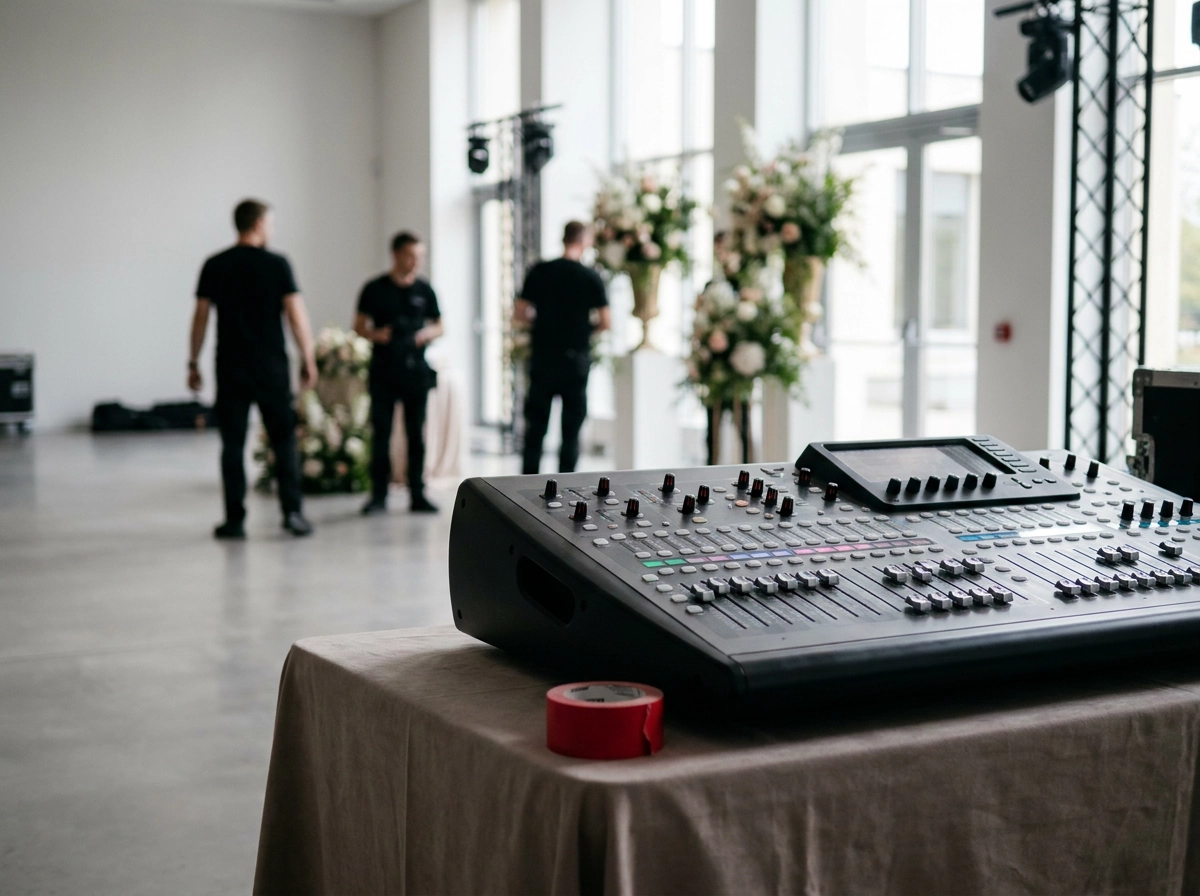
The Single Take Reality: Why Luxury Weddings Are Live Productions
A luxury wedding in the UAE is a live production with a single performance. There is no second night, no understudying a failed cue, and no post-show debrief that repairs a ruined moment. Every technical element, from the ceremony audio to the first dance lighting state, must be fully validated before the first guest crosses the threshold. What appears effortless to guests is the product of exhaustive pre-event testing conducted against the clock, with no audience to absorb the learning curve.
This is where the operational psychology diverges sharply from corporate production. A conference AV failure is recoverable: the session pauses, the technician reboots, the audience waits. A wedding has no such tolerance. The processional cannot be re-walked. The vows cannot be repeated because a microphone cut out. Corporate events have version two; a wedding has only the moment that already happened.
The distinction this creates for buyers is not about equipment quality. A competent audio visual service can deliver the right gear on schedule. What separates that from a true production partner is the capacity to hold a bespoke creative brief under pressure, to make decisions in real time that protect the emotional intent of the event rather than simply restore functionality.
That capacity only exists if it has been pre-built. Production partners operating at this level maintain contingency decision trees before the event begins, not during it. What is the protocol if a primary speaker fails 30 minutes before the ceremony? Who makes the call to switch to the backup system, and how is that transition executed without alerting a single guest? What happens if the lighting controller crashes mid-reception, or if the live stream signal drops during the first dance? These scenarios must have documented answers before load-in day.
This reframes the evaluation criteria entirely. The right question is not what equipment a firm carries. It is how they rehearse for failure when there is no rehearsal audience.
Bespoke Integration, Not Volume: What High-End Technical Production Actually Means
Volume is the wrong measure entirely. A ballroom filled with additional truss, extra speaker stacks, and redundant screens is not a luxury production; it is an accumulation. Without a governing creative brief, more equipment produces spectacle at the expense of experience. The distinction matters because guests feel the difference, even when they cannot name it.
The brief must establish emotional intent before any technical specification is written. What does the air feel like when guests step into the ceremony space? How sharply does the atmosphere shift the moment dinner transitions to dancing? At what precise instant is the couple revealed, and what should every person in that room feel simultaneously? Technology is engineered to serve those beats. It does not announce itself; it delivers the moment and disappears.
That service function demands that all technical systems operate as a single synchronized organism. Event lighting design, audio playback, live camera feeds, video programming, and speaker segments cannot function as parallel tracks running alongside each other. They must be designed, cued, and rehearsed as one integrated system, where a lighting state change and its accompanying audio cue arrive as a single perceptible experience, not two separate events that happen to coincide.
Immersive technologies, including hologram experiences, 3D projection mapping, and interactive LED integration, belong inside that organism from the outset. Immersive technologies are increasingly present in UAE luxury wedding briefs and should be considered by a credible production partner in the initial response, not proposed as late-stage upgrades. Understanding how a production house approaches that integration from day one is one of the most revealing qualification tests available; the guide on what a production house actually delivers and how to choose the right one sets out exactly what to evaluate.
The highest-performing productions share one defining quality: invisible coherence. When lighting transitions feel organic, audio levels shift without drawing attention, and visual moments land with emotional precision, the technology has done its job completely. That invisibility is not absence; it is mastery.
How Custom Lighting Cue Choreography Translates a Creative Brief into Atmosphere
Lighting cue choreography is where invisible coherence meets its most detailed engineering challenge.
Bespoke event lighting design begins with a cue map: a formal document that functions as a production script, assigning specific lighting states to named moments across the event timeline. Processional, vows, first kiss, first dance, surprise entertainment, and departure each carry a distinct emotional register, and each requires a pre-defined scene built before the event begins, not improvised by an operator reading the room.
DMX-controlled systems, operating on the ESTA E1.11 standard, allow lighting programmers to pre-program and trigger discrete scenes across the full event timeline. The result is deterministic execution: when the processional music begins, the aisle state fires precisely, without a decision being made in that moment. Improvisation is removed from the critical path entirely.
Four parameters govern every scene in the cue map: colour temperature, intensity, beam direction, and movement speed. Each is specified against the creative brief. Colour temperature calibration carries particular weight at filmed weddings. Colour temperature calibration must account for both the room experience and the lens simultaneously, what reads warmly to the human eye may shift unfavourably in captured footage or stills. Calibration must account for both the room experience and the lens simultaneously.
Luxury UAE venues compound this challenge. Palace ballrooms carry gilded surfaces with high reflectivity. Beachfront resort terraces present ambient light contamination at dusk. Private estates vary enormously in ceiling height and architectural geometry. These are not problems solved by importing a previous project’s programme file. Each venue demands a site-specific programming session, built from a physical walkthrough and measured against that space’s actual surface behaviour. The kind of precision this requires mirrors the technical discipline behind concert event management in the UAE, where site-specific staging and immersive sound design are engineered from venue data, not assumptions.
Before installation day, a production partner should deliver a formal lighting specification document: cue sequences with named triggers, equipment placement CAD drawings, and documented fallback states for every key moment. Buyers should request this document as a contractual deliverable, not an optional courtesy.
Wireless Audio in UAE Conditions: Signal Robustness Is Not a Given
The same precision applied to lighting cue architecture must extend to the audio layer beneath it, and in the UAE, wireless audio carries compounding environmental risks that do not exist at the same intensity anywhere else.
Outdoor luxury weddings in Dubai and Abu Dhabi operate within some of the world’s densest RF environments. Cellular network traffic, competing wireless systems from adjacent event spaces at multi-venue properties, humidity-driven RF absorption, and heat-related hardware degradation all converge simultaneously. A wireless microphone system performing flawlessly in a controlled indoor setting can become unreliable on a beachfront terrace in summer. This is not a theoretical risk; it is a documented operational condition that demands engineered responses, not optimism.
For sound systems in event management at this level, line array configurations with acoustic modeling software are the starting point, not a premium option. Engineers use coverage prediction tools to map sound pressure levels across the venue geometry before a single speaker is flown, eliminating dead zones and removing the need for visible floor monitors that compromise the aesthetic field.
Frequency coordination is equally non-negotiable, and it must happen before event day. The UAE’s Telecommunications and Digital Regulatory Authority requires spectrum authorisation for wireless transmission equipment at events, yet this compliance step remains widely overlooked across the industry. Professional audio visual setup means scanning the RF environment at the specific venue, on the specific date, to identify clear channels before a single microphone is activated. Conditions on the day of a site visit three weeks prior are not the conditions on event day.
Redundancy architecture must be built into the system design: backup transmitters, spare receiver channels, hardwired fallback paths for officiants and live musicians, and a dedicated audio engineer monitoring signal health throughout the entire event.
The convergence point with lighting cannot be overstated. When lighting cues are triggered by audio timecode, a signal dropout does not affect audio alone; it breaks synchronisation across every system tied to that timeline. A single transmission failure becomes a production failure.
Cable Management and Aesthetic Concealment as a Core Production Competency
The signal integrity challenges explored in the previous section have a spatial counterpart: every cable that cannot be made wireless must be made invisible. In a luxury wedding environment, a visible cable is not a minor oversight. It is evidence that the technical layer was installed on top of the design rather than embedded within it, and sophisticated guests notice.
The primary tools for a clean visual field are wireless audio systems, battery-powered LED fixtures, and pre-laid conduit routes through venue infrastructure. Each carries engineering tradeoffs that must be resolved before installation day, not during it. Battery-powered fixtures eliminate power runs but require discharge scheduling and swap protocols for multi-hour events. Pre-laid conduit depends on advance venue access that must be negotiated and confirmed in writing. Wireless systems demand their own frequency coordination, as covered in the audio section.
Power distribution compounds the challenge significantly. Large-scale event lighting services draw substantial loads across multiple circuits, and balancing those loads across primary and backup electrical networks requires formal electrical planning, not site intuition. Concealing distribution boards, cable trunking, and generator feeds within bespoke floral installations, custom furniture arrangements, or architectural features is only possible when the technical team and the décor supplier are working from the same spatial plan from the outset. A florist who learns about power infrastructure requirements on installation day cannot retroactively design concealment into a centrepiece.
Overhead infrastructure introduces a separate constraint. Rigging load plans, certified truss systems, and structural assessments define precisely where equipment can be suspended. Those positions determine sightlines, which in turn determine how long cable runs must be and where they must travel. Aesthetic concealment for the entire venue flows from those rigging decisions, making structural planning an upstream creative input, not a technical afterthought.
This is why the venue walkthrough must include the interior designer and floral team alongside the technical crew. Understanding what professional audio visual services for events actually include makes clear that concealment is never a single-discipline problem. A technical team solving it alone will always leave traces.
Live Streaming at Luxury Weddings: Seamless Broadcast Without a Visible Crew
Broadcast infrastructure demands the same concealment discipline applied elsewhere in the production. Hybrid guest participation is now a routine request at UAE luxury weddings, with families spread across the Gulf, South Asia, Europe, and beyond expecting real-time access to the ceremony.
The challenge is not streaming capability. Any competent audio visual service can point a camera at a ceremony and push a signal online. The challenge is streaming invisibility: every camera body, every operator, and every metre of broadcast infrastructure must disappear from the guest experience, from the photographs, and from the couple’s own memory of the day.
Achieving that invisibility in a luxury venue requires a specific camera architecture. Discreet camera positions on columns or balcony mounts handle wide establishing angles without placing an operator in the frame. Long telephoto lenses operated from gallery-level positions capture intimate moments from distances that keep crew entirely out of sightlines. A dedicated video director manages the live cut from an off-floor control position, making editorial decisions without ever stepping onto the event floor.
Dedicated signal transport from each camera position to the production hub, whether via pre-laid cabling or wireless video systems, must be planned during the venue walkthrough and stress-tested before event day. This must be treated as part of the cable concealment strategy, not as a separate technical afterthought.
Platform configuration and failover protocols are equally the production partner’s responsibility. Latency settings that suit a broadcast environment differ from those appropriate for a private streaming link watched on a mobile phone in another time zone. A buffering stream at the moment of the vows is not a technology inconvenience; it is a fundamental failure to deliver the service commissioned. Understanding what separates a genuine production professional from adequate delivery is precisely this level of end-to-end ownership, where the brief extends to every screen a guest will watch on, regardless of where in the world they are sitting.
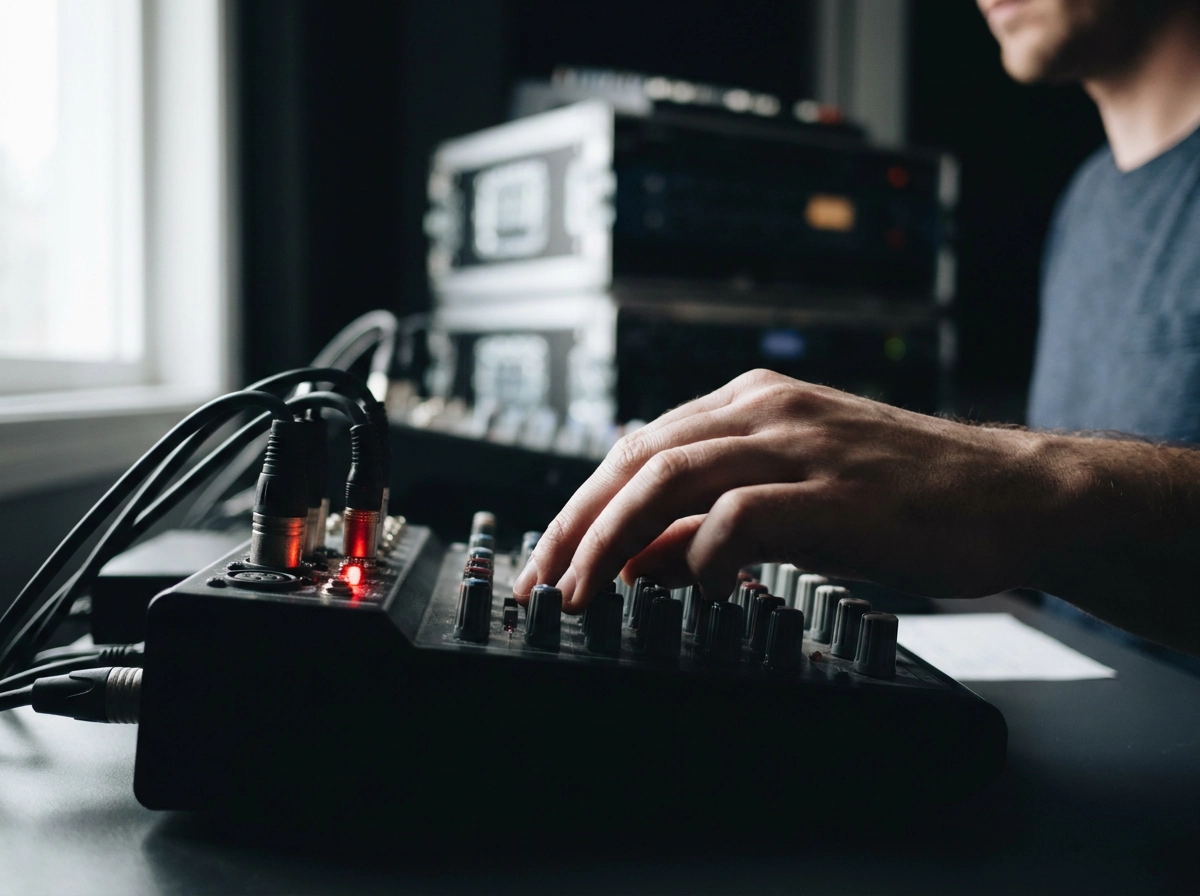
System Synchronization: The Architecture That Makes Everything Feel Effortless
Invisible streaming infrastructure is only half the coordination problem. The harder challenge is ensuring that every system feeding, triggering, and responding to that stream, and to every other live moment, fires as a single unified sequence rather than a collection of independent actions.
This is where synchronization architecture separates a true production partner from a group of individually skilled subcontractors. Sound, lighting, video playback, live camera feeds, and performer cues each managed by a specialist team mean nothing unless those teams operate from a shared trigger framework. When they do not, the gaps show: a lighting state that arrives a beat late on the first dance, a video transition that fires before the music resolves, a spotlight that misses its mark because one operator was waiting for a verbal cue that the other had already passed.
Automated cue systems driven by audio timecode, described in the lighting section, provide the synchronisation backbone; the formal cue sheet maps every trigger, system, and fallback action for all crew simultaneously.
That documentation must then be tested. Technical rehearsals without the wedding party present are non-negotiable. Crew members walk every automated sequence end to end, standing in for the couple and guests to validate timing, sightlines, and system response under live conditions. Understanding how audio post production shapes event memory across complex multi-system productions reinforces why this rehearsal stage is where synchronization problems are solved, not discovered.
When evaluating production partners, ask directly: describe your cue management system, show past cue documentation, and explain how you handle a synchronization failure mid-ceremony. Equipment renters do not have a rehearsed answer. Operational partners do.
Regulatory Compliance in the UAE: Non-Negotiable from Day One
In the UAE, regulatory compliance is not a procedural layer added after the creative work is done; it is a structural precondition that shapes what can be physically built, how it must be powered, and what emergency provisions must exist before a single guest arrives.
Dubai Municipality and Dubai Civil Defence approvals govern hard technical realities. Responsible production partners ensure rigging configurations are supported by structural load documentation reviewed against the specific venue’s ceiling or truss infrastructure. Electrical systems must be documented with formal distribution diagrams that satisfy civil authority standards, not adapted from a previous event’s paperwork. Emergency egress plans are not optional annexes; they determine where equipment can be positioned and where it cannot. These requirements are not administrative formalities that experienced partners manage quietly in the background. They are engineering constraints that must be embedded into the production design from the first technical drawing.
The UAE’s Events Licensing System reflects a multi-stage approval logic. Responsible production partners work through concept approval, venue permits, risk assessments, and technical sign-offs, each with its own authority and documentation standard. A production partner who treats these stages as familiar operating territory, rather than obstacles to be navigated last-minute, demonstrates the kind of institutional knowledge that separates genuine UAE production expertise from generalist audio visual equipment rental. Compliance infrastructure is not a specialisation; it is the floor.
Cultural compliance carries equal operational weight. Technical scheduling should account for prayer times from the outset, not adjusted reactively when a run-of-show conflict appears. Restricted dates during religious observances must be identified at the planning stage. The event flow itself, including entertainment timing, lighting transitions, and hospitality sequencing, should reflect Emirati values as a design input, not as a post-production sensitivity check.
Any production partner who presents regulatory compliance as a premium service offering is signalling that it sits outside their standard practice. For a tier-1 firm operating in this market, it is simply the baseline.
The Production Team Behind the Brief: Roles, Workflows, and What to Demand
Regulatory compliance establishes the legal foundation. What delivers on that foundation is the people, structure, and discipline behind the brief.
A luxury wedding technical production team is not a two-person AV crew. It spans sound technicians, lighting programmers, video specialists, rigging leads, stage coordinators, and a technical manager. When multi-vendor coordination is factored in across venues, catering, florals, and entertainment, the full production requires numerous professional roles working in concert. Each specialist owns a defined domain; the technical manager owns the integration between them.
That integration cannot be improvised across a lengthy engagement. The structured workflow, from initial consultation through venue walkthroughs, CAD design, equipment specification, installation scheduling, technical rehearsal, and live oversight, must be codified into a shared project milestone schedule. Clients should receive this document, not hear about it informally. A production partner who cannot produce a written timeline with named deliverables is managing the engagement in their own head, which is operationally unacceptable at this level.
On-site project management is where UAE-specific expertise becomes critical. Local traffic patterns, customs clearance timelines for imported equipment, and venue-specific access windows are variables that cannot be learned on the day. A dedicated project manager who knows these constraints is not a cost overhead; it is the mechanism that prevents a delayed freight clearance from cascading into an incomplete installation 48 hours before the event.
Communication standards must be explicit before contracting. Defined response windows, immediate escalation protocols for urgent matters, and a single named contact who owns the client relationship from brief to debrief are the minimum. These are standard expectations across every premium vendor a couple will engage; technical production should be no different.
Finally, ask for a named crew list with verifiable credentials before signing any agreement. A generic assurance of “experienced professionals” is not acceptable. Every crew member assigned to the event should be briefed on the couple’s specific cultural context, personal sensitivities, and the event’s tone. Technical excellence without cultural awareness is incomplete execution.
What to Actually Demand from a High-End Audio Visual Service Provider
Knowing who will be on-site is necessary. Knowing what to demand before you sign the contract is what separates a well-staffed event from a genuinely protected one.
Demand a formal site assessment report and acoustic model before any equipment is specified. A production partner who moves directly to a kit list is designing from assumptions. The assessment should document ceiling heights, surface reflectivity, RF environment conditions, power capacity, and structural load points specific to your venue. Without it, equipment choices are guesses dressed as recommendations.
Ask for a lighting cue map and synchronisation script built for your event. As detailed in the lighting section, bespoke event lighting design produces a named, documented cue structure with specified fallback scenes. If a prospective provider cannot deliver this before installation day, their approach is template-based, not brief-driven.
Require verifiable evidence of UAE regulatory compliance. As covered in the compliance section, a firm that operates within the approval system carries the paperwork; ask to see it. One that works around the process carries the risk onto your event.
Evaluate contingency architecture as a core competency, not an afterthought. Ask directly: when primary equipment fails mid-ceremony, who makes the call to switch, how quickly, and through what decision chain? A credible answer names the decision authority, describes the backup systems already in position, and explains how the transition remains invisible to guests. Vague reassurances about “backup gear on standby” are not architecture.
Require a line-item budget breakdown for your luxury audio visual setup. Equipment, crew, logistics, compliance costs, and contingency reserves should each appear as separate figures. A single total without supporting detail does not reflect pricing confidence; it reflects an unwillingness to be examined. Transparency at proposal stage predicts transparency under pressure.
Conclusion: The Brief Is the Production
The demands outlined above share a common premise: a luxury wedding brief is not a procurement document. It is a production architecture document, one that maps emotional intent to engineered execution across lighting, audio, video, and synchronisation systems simultaneously. Every specification, every cue sequence, every contingency protocol flows from that brief outward. Buyers who treat it as a shopping list will receive a shopping list back.
The production partners worth commissioning are those who respond to a brief by making it more precise. They ask harder questions about moment sequencing, surface-level ambiguities in the creative vision, and failure scenarios the client has not yet considered. They produce documentation that makes the production reproducible even when venue conditions shift, crew members change, or timelines compress. That discipline is not a premium service tier; it is the minimum standard for an event with no second take.
At Nexus Events, 25 years of combined production experience across UAE luxury weddings, concerts, and international productions shapes how we receive and develop a brief. Sound, event lighting design, and visual systems are engineered around each couple’s vision from the outset; they are not bolted onto a standard package after the décor decisions have been made. Our certified team handles every layer of the production architecture, from acoustic modelling and DMX cue programming to regulatory compliance and on-site crew coordination, because coherence across systems is the product.
Buyers who have worked through the criteria in this piece will ask fundamentally different questions in their next supplier conversation. They will recognise the difference between a firm that presents capability and a firm that demonstrates process. They will reject proposals that lack cue documentation, contingency architecture, or line-item transparency.
The distinction between a wedding people remember and one they merely attended is almost always invisible. Guests do not notice the wireless frequency coordination, the pre-laid conduit, or the automated lighting cue that lifted the room at precisely the right moment. They only feel the result. That invisibility is the highest form of technical craft, and it is what a genuine production partner delivers.